
Whitepapers
SAP Assessment: The Critical First Step

1. Executive Summary
Even well-funded transformations fail without a clear starting point. Bain & Company reports that 88% of business transformations miss their original goals ⁽¹⁾, often due to vague objectives, fragmented execution, or misalignment between business and IT.
The SAP landscape tells the same story: only 32 % of customers had completed their move to S/4HANA by early 2025, and another survey shows 57% of ECC users doubt they will finish before mainstream maintenance ends in 2027. ⁽²⁾ ⁽³⁾ Delay is expensive.
Before organizations can scale AI, analytics, or advanced automation, they must first establish trusted data, clear governance, and an executable ERP roadmap.
A strategic SAP Assessment serves as this execution entry point by:
- Linking strategy to execution across business and IT
- Mapping practical migration paths that integrate people, processes, and technology
- Setting measurable checkpoints to keep momentum on track
Whether you are migrating to S/4HANA, integrating systems after a merger, or untangling a complex SAP estate, an Assessment clarifies priorities, reduces risk, and delivers a realistic roadmap grounded in current-state analysis and rapid prototyping.
2. Why SAP Projects Derail Before They Start
Slideware on its own rarely secures project success. When stalled programs are reviewed, the root causes fall into three key categories:
1. Lack of Clarity & Alignment
– Teams begin with different views of the current state and the desired future state. Scope changes multiply and commitment erodes because business and IT never share a single, binding vision. McKinsey research notes that roughly 70 % of large-scale transformations fail to reach their stated goals. ⁽⁴⁾
2. Cross-functional Priority Conflicts
– Each function advances its own agenda. Consensus stalls, scope drifts, and decision cycles lengthen—driving up cost and extending timelines before execution even begins.
3. Extended Analysis Cycles
– Interview-heavy assessments gather fragmented information; requirements clash, and designs keep shifting. Stakeholders suffer analysis fatigue, and budget overruns mount long before implementation.
Key takeaway: projects succeed or fail in their opening moves. A disciplined Assessment aligns everyone early and locks in a roadmap the enterprise can trust.
3. What a Strategic SAP Assessment Answers
- Which business problems matter most?
- Where are we gaining or losing value right now?
- What future capabilities will keep us competitive?
- How do people, processes, and systems evolve together?
- What will it realistically take in cost and time to get there?
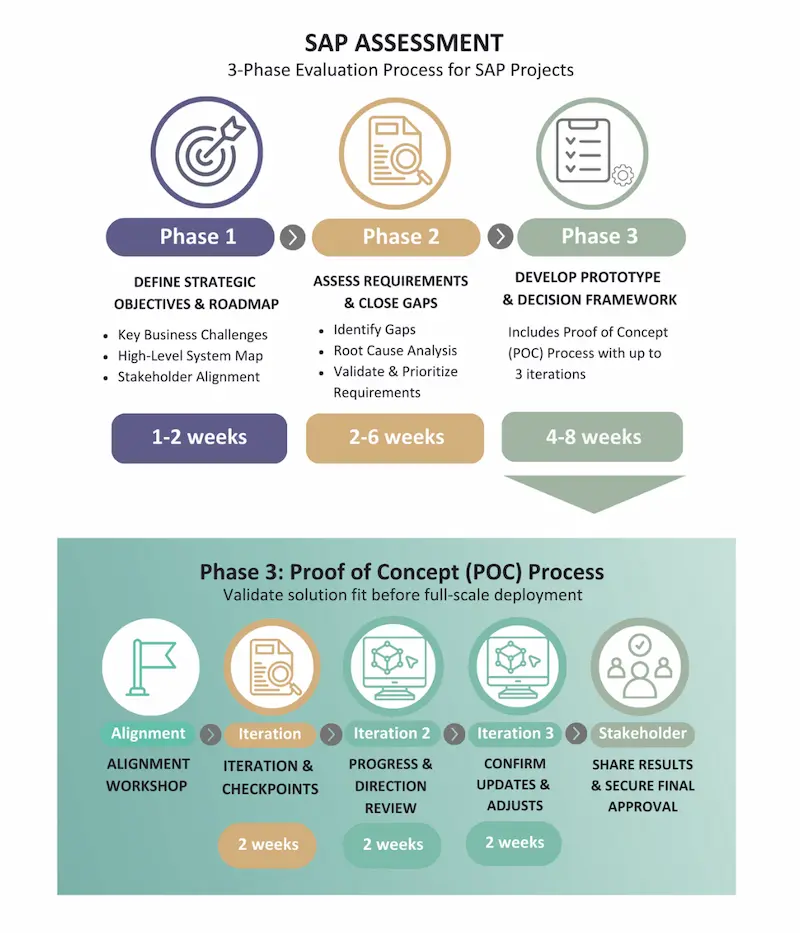
4. Three-Phase Assessment Approach
Phase 1 – Define Strategic Objectives & Roadmap (~1-2 weeks)
- Define Key business challenges and required capabilities
- Draft a one-page system blueprint showing SAP components, data flows, and integrations
- Confirm direction in a joint read-out with business and IT leaders
Phase 2 – Assess Requirements & Close Gaps (~2-6 weeks, scope-dependent)
- Identify capability and process gaps
- Trace root causes behind each gap
- Validate and rank requirements before design is finalized
Phase 3 – Develop Prototype & Decision Framework (optional, ~4-8 weeks)
- Provision a non-production SAP environment in AWS (or the client’s cloud) with sample data
- Demonstrate end-to-end process flows and integrations
- Use results to finalize the to-be implementation roadmap—confirming effort, sequence, and risks
5. What Makes Our Assessment Different
- Top-Down Alignment – design-thinking workshops refined in 400 + projects compress discovery and build consensus fast
- Strategic SAP Architecture Skill – architects with 20–35 years of SAP experience ensure every design is technically sound and business-relevant
- Speed with Thoroughness – a lean delivery model cuts elapsed time while maintaining full analytical depth
6. Who Should Use an SAP Assessment
- Organizations improving existing SAP processes or unlocking unused licenses
- Enterprises planning to deploy S/4HANA, SAC, IBP, Concur, and related solutions
- Firms evaluating an ECC-to-S/4HANA migration ahead of 2027 support retirement
- Businesses needing a clear ERP-transformation roadmap
- Companies integrating new entities quickly after mergers or acquisitions
7. Business Use Cases: Post-Merger Integration
Situation
A US-based grocery chain acquired a regional competitor and selected S/4HANA as the common platform to onboard stores quickly and demonstrate merger synergies.
Action
- One-week alignment workshop with executives and key business / IT leaders
- 25 working sessions over six weeks to refine requirements and design
Key outcomes
- Five-year roadmap endorsed by all stakeholders
- Executive approval and funding—architecture approved, budget secured, rollout dates confirmed
- Targeted “fix-first” list—each pain point matched to the capability that resolves it
8. Summary & Next Steps
Most SAP programs fail in planning, not execution. A strategic assessment establishes a solid foundation from day one.
Interested in an initial discussion?
We offer engagement tiers ranging from rapid readiness diagnostics to comprehensive migration strategy design.
9. Resources
- Bain & Company – “88% of business transformations fail to achieve their original ambitions; those that succeed avoid overloading top talent” (2024)
https://www.bain.com/about/media-center/press-releases/2024/88-of-business-transformations-fail-to-achieve-their-original-ambitions-those-that-succeed-avoid-overloading-top-talent/
- SAP insider – “Grab That Nutella (and the Future): How SAP, Intel, and Lenovo Are Building Tomorrow’s Retail” (2025)
https://sapinsider.org/map/grab-that-nutella-and-the-future-how-sap-intel-and-lenovo-are-building-tomorrows-retail/
- Basis Technologies – “The True State of S/4HANA 2025” (2025)
https://www.basistechnologies.com/blog/the-true-state-of-s4hana
- McKinsey & Company, Common Pitfalls in Transformations: A Conversation with Jon Garcia (March 29, 2022)
https://www.mckinsey.com/capabilities/transformation/our-insights/common-pitfalls-in-transformations-a-conversation-with-jon-garcia
Co-authored by Saison Technology International and Rock15 Consulting (August 2025)